Understanding your camera type
You do not need the newest or most expensive camera to learn photography, but you do need to know what sort of camera you have. That tells you which controls, lenses and instructions on this course apply directly to you.
Before you start
Have the camera or phone beside you while you read. Do not try to memorise the page. Find each control or try each idea as it is explained. If a term is unfamiliar, the explanation here matters more than remembering the name.
Start with the make and model
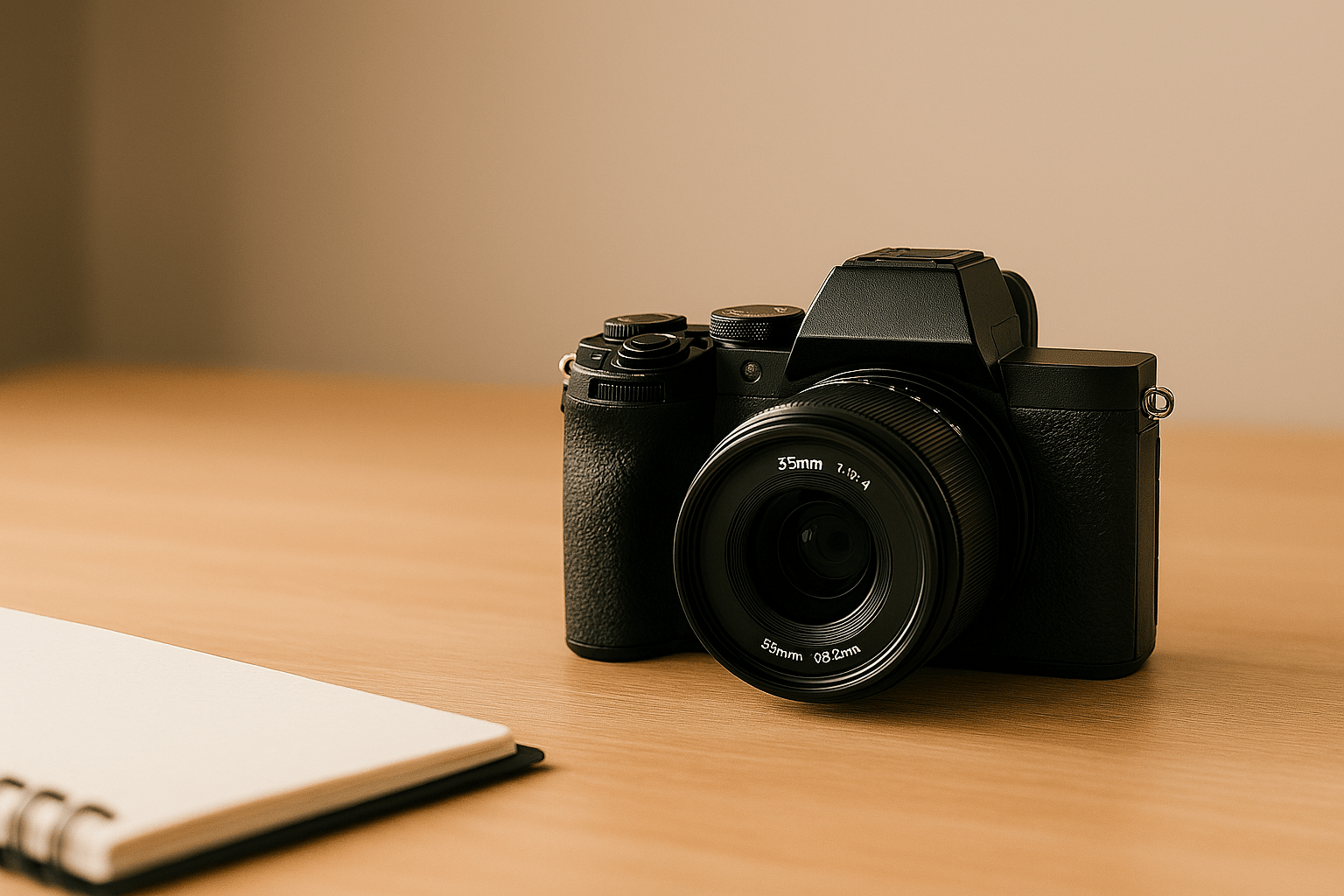
Look on the front, top or bottom of the camera for the manufacturer and model name. Write it down. If the lettering is unclear, the model is often shown on the box, receipt or in the camera's information menu.
Does the lens come off?
If the lens can be removed and replaced, you have an interchangeable-lens camera. Modern examples are usually mirrorless cameras or DSLRs. Do not remove the lens just to test this unless you already know how the release works.
DSLR or mirrorless
A DSLR uses a mirror and optical viewfinder system. A mirrorless camera does not use that DSLR mirror mechanism and normally gives you an electronic viewfinder, rear screen, or both. For a beginner, the practical difference is less important than learning the controls your own camera provides.
Compact and bridge cameras
A compact camera normally has a permanently attached lens and is designed to be small. A bridge camera also has a fixed lens but often has a larger body, a substantial zoom range and controls that resemble an interchangeable-lens camera.
Phones are cameras too
A smartphone may use several small camera modules and a great deal of automatic processing. You can still learn composition, light, timing, exposure and editing with it, even when it does not offer the same physical controls as a dedicated camera.
Common mistakes
- Assuming a large camera is automatically better than a small one.
- Buying accessories before checking the exact model and mount.
- Following instructions for a different camera and assuming yours must have the same buttons.
- Thinking an automatic camera prevents you learning photography. The photograph still depends on light, viewpoint, timing and composition.
What you should be able to do before moving on
You should finish with a simple description such as: 'I have a Canon EOS 250D DSLR with interchangeable lenses' or 'I have an iPhone with three rear camera modules'. That is enough to know which instructions are relevant.
If that still feels uncertain, repeat the practical. There is no benefit in rushing to the next lesson with a gap in the basics.
OPEN THE PRACTICAL